
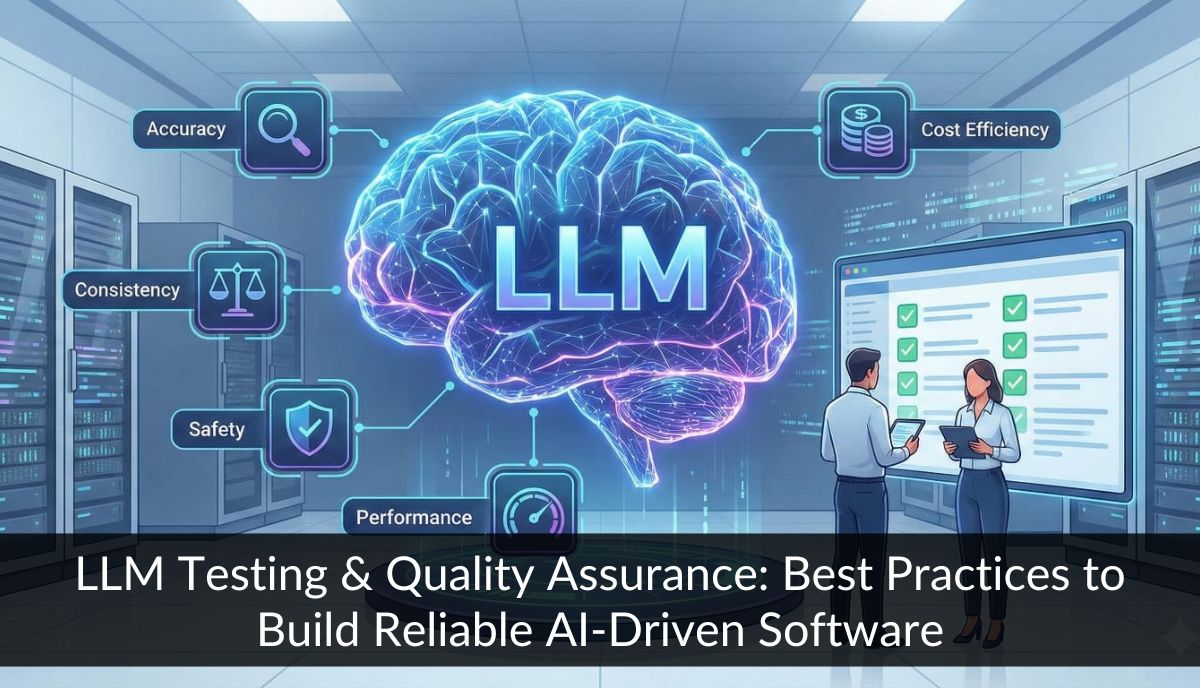
Large Language Models (LLMs) are rapidly becoming the backbone of modern applications – powering chatbots, copilots, enterprise search, recommendations, and intelligent automation.
As organizations race to integrate AI into their products, testing and quality assurance for LLM-powered systems have emerged as critical blind spots.
Traditional QA approaches alone are no longer sufficient.
This blog explains what LLM testing is, why it is fundamentally different from conventional software testing, the key quality risks involved, and the best practices QA teams must adopt to deliver reliable, production-ready AI-driven software.
What Is LLM Testing?
LLM testing is the practice of validating the accuracy, consistency, safety, performance, cost efficiency, and reliability of applications powered by large language models across real-world usage scenarios.
Unlike traditional software testing, which focuses on deterministic inputs and outputs, LLM testing emphasizes behavior, risk, and trust, ensuring AI systems behave responsibly, predictably, and at scale.
Why LLM Testing Is Fundamentally Different
Unlike traditional software systems, LLM-powered applications are:
- Non-deterministic – The same input can generate different outputs
- Probabilistic – Correctness is contextual, not binary
- Prompt-driven – Small prompt changes can significantly alter behavior
- Continuously evolving – Model updates can introduce silent regressions
Because of this, conventional “expected vs actual” testing models break down.
LLM quality assurance must focus on behavior validation, risk mitigation, and trustworthiness – not just functionality.
Core Quality Risks in LLM-Powered Applications
Before defining testing strategies, teams must understand the risks unique to AI-driven systems.
1. Hallucinations & Incorrect Outputs
LLMs can confidently generate incorrect or fabricated information, damaging user trust and business credibility.
2. Inconsistent Responses
Outputs may vary across users, sessions, or environments, breaking reliability expectations.
3. Bias, Safety & Compliance Risks
AI-generated content may unintentionally introduce bias, unsafe language, or regulatory violations.
4. Performance & Cost Issues
Latency spikes, inefficient prompts, and token overuse can significantly increase operational costs.
Best Practices for LLM Testing & Quality Assurance
1. Prompt-Based Test Design
Instead of static test cases, QA teams should build prompt libraries covering:
- Happy paths
- Edge cases
- Ambiguous inputs
- Adversarial and misuse scenarios
Each prompt becomes a test scenario, not just an input.
2. Define Quality Metrics Beyond “Correctness.”
Effective LLM QA measures:
- Factual accuracy
- Contextual relevance
- Response completeness
- Tone, safety, and compliance
- Consistency across runs
These metrics provide measurable quality signals, not subjective opinions.
3. Regression Testing for Model & Prompt Changes
Every model upgrade, prompt tweak, or configuration change can alter behavior.
Best practices include:
- Snapshotting baseline responses
- Running automated comparison tests
- Detecting semantic drift, not just text differences
This prevents silent regressions from reaching production.
4. Automate LLM Testing with AI-Assisted Validation
AI itself can be used to scale LLM testing by:
- Generating large volumes of test prompts
- Classifying outputs (correct, risky, hallucinated)
- Detecting anomalies across thousands of responses
This makes LLM testing scalable, where manual validation alone is impractical.
5. Human-in-the-Loop Validation
For high-risk use cases such as finance, healthcare, legal, or customer support:
- Combine automated validation with expert human review
- Prioritize scenarios using risk-based scoring
This hybrid approach balances speed, accuracy, and accountability.
Who Should Invest in LLM Testing?
LLM quality assurance is critical for:
- Product teams building AI copilots or assistants
- Enterprises integrating GenAI into business workflows
- SaaS platforms using LLM-powered search or chat
- Regulated industries deploying AI-driven systems
In these environments, quality failures directly impact user trust, compliance, and brand reputation.
LLM Testing in Real-World Applications
LLM QA plays a vital role across multiple use cases:
- AI chatbots & virtual assistants – response accuracy and safety
- Enterprise search & knowledge assistants – factual correctness
- Customer support automation – tone, escalation, and compliance
- Internal productivity tools – reliability and consistency
In each case, quality is not optional; it is foundational.
How QualiTlabs Supports LLM Quality Assurance
At QualiTlabs, we help teams move from experimental AI to production-ready LLM systems through:
- LLM-specific QA strategy and test design
- Prompt-based and scenario-driven testing
- AI-assisted automation for large-scale validation
- Bias, safety, and compliance testing
- End-to-end QA across web, mobile, API, and AI layers
Our approach focuses on measurable outcomes, not just test execution, helping teams release AI features with confidence.
Final Thoughts: Quality Is the Foundation of Trustworthy AI
LLMs are powerful, but without the right testing strategy, they introduce new risks rather than drive innovation.
Quality assurance for LLM-powered applications is no longer optional.
It is a strategic requirement for any organization building AI-driven software.
Teams that invest early in LLM-focused QA practices will ship faster, reduce risk, control costs, and earn lasting user trust.
Validate Before You Scale
Validate quality, risk, and cost before scaling AI to production.
Reach out to sales@qualitlabs.com to run a no-cost PoC and experience how QualiTlabs delivers tangible quality outcomes, reduced risk, and faster releases using AI-powered quality engineering.